How to price your items on Vinted
· 6 min read
Pricing is where most resellers lose money, in both directions. Too high and the item sits for months, quietly costing you storage and attention. Too low and you've done all the work of photographing, writing and shipping for a couple of euros. The fix is not intuition — it's a repeatable comparison.
How do you price an item on Vinted?
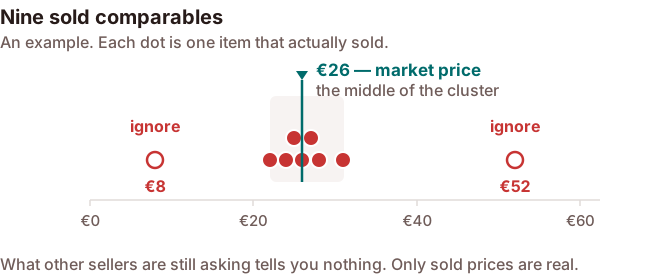
Find five to ten sold examples of the same brand and item in comparable condition, ignore the outliers at both ends, and take the middle of that cluster as the market price. Then adjust for brand demand, condition, size and season. Compare against what sold, never against what other sellers are still asking.
Why compare against sold items, not listed ones?
This is the whole method, and almost everyone gets it wrong. What other sellers are asking tells you nothing, because unsold listings are by definition priced at a level nobody accepted. On Vinted, look at what has actually sold rather than what is still sitting in the catalogue — those are real transactions at real prices.
Find five to ten sold examples of the same brand and item in comparable condition. Ignore the outliers at both ends. The middle of that cluster is the market price, and your item is worth a bit more or less depending on the factors below.
If you can't find any sold comparisons, the item is either rare or nobody wants it. Those look identical until you check.
What actually moves the price?
| Factor | Impact | What it does to the price |
|---|---|---|
| Brand demand | Largest | The gap between a sought-after brand and an unknown one is larger than every other factor combined |
| Condition | Strong | New with tags earns a real premium; visible wear discounts hard, and a repairable flaw discounts less than people fear |
| Size | Moderate | Mid sizes sell fastest; very small and very large take longer but hold price better, because supply is thinner |
| Season | Moderate | A winter coat listed in July sits; the same coat in September sells in days, at a higher price |
| Colour and print | Smaller | Neutrals sell steadily; bold prints sell slower, but to buyers who will pay more for exactly that |
Why price in the buyer's fees?
What you list at is not what the buyer pays. Vinted adds buyer protection and postage on top, and the buyer is comparing that total. An item listed at €25 with €4 postage competes against one listed at €20 with free postage — and loses, even though you are cheaper.
Work backwards from the total you think the item is worth to the buyer, then subtract postage to get your list price. Bundling postage into the price often works better than showing it separately, because the number the buyer sees at checkout is the one they judge.
Leave room, but not much
Vinted buyers expect to make an offer, so listing at exactly your floor means every negotiation loses you money. Adding 10–15% is enough to absorb a reasonable offer and still hit your number.
Adding 50% is not a negotiating position, it's a filter that removes you from search results. Buyers sort by price. A wildly optimistic listing isn't seen and then rejected — it is never seen at all.
Have a drop schedule
Decide the schedule when you list, not when you get impatient. A rule that works for most inventory:
- Week 1–2: leave it alone. Listings get their visibility burst early.
- Week 3: drop 10%. This often re-surfaces the item and notifies people who favourited it.
- Week 5: drop another 10–15%.
- Week 8: bundle it, or accept the best offer you've had.
The point of a schedule is that it removes emotion. An item that hasn't sold in eight weeks is not underpriced by a euro — the market has told you your number was wrong, and holding out costs more than the difference.
Know your floor
Before listing, work out the number below which you'd rather keep or donate the item. Include what you paid, the postage you'll cover, the marketplace's cut, and — honestly — the twenty minutes of photographing, writing and packing.
For a lot of low-value items that calculation ends with "this isn't worth listing individually", and that is a useful answer. Bundling five €3 tops into one €15 lot is the same revenue for one fifth of the work, and it clears space for items that actually earn.
The short version
- Price against sold items, never against active listings.
- Brand demand matters more than everything else put together.
- Think in totals — the buyer sees price plus postage.
- Add 10–15% for negotiation, not 50%.
- Set the drop schedule up front and follow it.
- Know the floor where the item isn't worth your time.
ListQuick is independent and is not affiliated with, endorsed by, or connected to Vinted. Vinted is a trademark of its respective owner and is referred to here only to describe where this guide applies.